

Crucial Maintenance Tips for European Cars in Medway
There is no doubt that driving high-end European cars like BMW, Audi, Mercedes, Mini, Porsche, Volkswagen, and Volvo offers a thrill unlike any other. However, these luxury cars require proper maintenance to run smoothly and perform at their best.
In fact, at Medway Imports, located near you in Medway, MA, our team of certified mechanics with years of experience fixing high-end European cars will share critical tech tips to help European car owners ensure the best possible care for their vehicles.
Best Tips:
Please call 508-533-3555 today for more information or to schedule your appointment or click here to schedule an appointment online.
Manufacturer-Recommended Service Schedule
One of the most important aspects of maintaining your high-end European cars is following the manufacturer-recommended maintenance schedule. In fact, the maintenance requirements of European cars completely differ from those of general vehicles.
The maintenance schedule designed by European car manufacturers prioritizes preserving the vehicle’s performance and safety. Now, when you follow the manufacturer-recommended maintenance schedule, you can rest assured that the professionals will take care of all the critical components in your vehicle.
Most of the time, skipping or delaying the manufacturer-recommended maintenance schedule for European cars often results in inflated repair bills, as the major components in your car are damaged.
Tackle Warning Lights Quickly
Nowadays, all modern European cars are equipped with a host of dashboard warning lights linked to specific components. Whenever these parts malfunction, the warning light associated with the failing component illuminates.
In fact, the warning lights can illuminate due to minor or major issues with your European car. That is why you must always pay immediate attention if you see a flashing check engine light or other dashboard warning lights.
In fact, there are certain warning lights found in high-end European cars, such as the DPF and AdBlue lights, that should be addressed immediately.
Maintain the Braking System
The braking system is one of the most important components in your vehicle, helping not only stop the vehicle but also improve its efficient handling. In fact, the components of the braking system require constant monitoring and timely maintenance to ensure your car’s safety.
Moreover, certain European cars are equipped with ceramic rotors or high-performance brake pads, which require regular inspection by professional mechanics. In addition, using Original Equipment Manufacturer (OEM) parts to replace your brake system components is very important.
Fix Engine Performance Issues Quickly
Generally, as your car accumulates miles, its engine tends to experience performance issues due to wear and tear on its internal components. That is why some European car owners report experiencing engine misfires, rough running, and reduced engine power.
Most of the time, these issues are caused by a defective ignition coil, turbocharger failure, or excessive carbon buildup, all of which need to be addressed immediately. In fact, luxury European cars come equipped with high-compression engines that are prone to damage if not properly maintained.
It is important to address any engine performance issues early to prevent additional damage to other components.
Timing Belt
Timing belt non-interference & interference engines as you guessed…Interference = BAD!
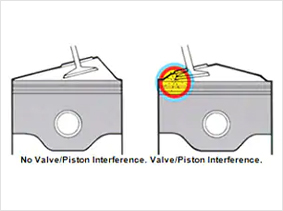 Timing belt-equipped car engines can be classified as either free-running or interference, depending on what occurs if piston/valve synchronization is lost due to a failed timing belt. As illustrated above, an interference engine usually sustains damage if synchronization is lost. This could result in very expensive engine repairs.
Timing belt failure on interference engines can result in serious engine damage. See manufacturer’s maintenance manual for specific information. Belts of similar dimensions and tooth profiles are not interchangeable due to varying construction features. Misapplication of belts voids manufacturer’s warranty.
Rattling Noise
Hear a scraping or rattling noise on your Mercedes V/6 or V/8….STOP!!
A five minute inspection could save you thousands!!!
Mercedes Harmonic Balancer
Also know as:
Crankshaft pulley
Vibration damper

This one came apart, damaging the timing case & radiator

Here is a new balancer
Oil Leaks
I’ve had plenty of conversations about the root cause of oil leaks being increased crankcase pressure and not necessarily a failed gasket. Many times this helps actually solve the root problem instead of simply fixing a symptom. Especially when the customer brings me an estimate from another shop with a recommendation for replacing a valve cover gasket and nothing else. Education is key and it shows that we do a complete repair not simply a more expensive one. However, once that education is planted some customers do return to the original shop for the work to be completed and then use the information we provide as leverage when the car leaks oil again.
Long story short not only do we need to strive to educate our customers but also other technicians. Having a service advisor and a customer on the same page is fantastic but when the entire facility shares a common understanding you can truly develop a long term client relationship. Long story short, not only do we need to strive to educate our customers but also other technicians. Having a service advisor and a customer on the same page is fantastic, but when the entire facility shares a common understanding you can truly develop a long term client relationship.
2003 BMW 540

The result of engine oil leaks and extended oil change intervals, this view is the back of a BMW engine with the transmission removed. In addition to the valve cover gaskets, intake gaskets, valley pan, the rear main seal was also leaking, the cyclone pump and suction pump were clogged.
This is the BEFORE picture!

We replaced the leaking gaskets as well as the cyclone pump and the suction pump.
Oil Level
Checking oil level on an air cooled 911
For Porsche models 3.0 SC, 3.2 Carrera, 964, Turbo I, Turbo II, 993.
So often it is done wrong, and not just by the owners. You must check while running and when truly hot.
Often garages that are unfamiliar with the correct procedure get it wrong. And too much oil can be bad news. It’s easier to check after a drive.
Inside the car you have an oil level indicator (right beside the fuel level). This shows the level in the oil tank.
In the engine compartment you have a dipstick. It too shows the oil level in the tank. You can check the dipstick to make sure the gauge is telling the truth. The procedure is exactly the same.
- Your Porsche must be at running temperature…i.e. it must have been running for 15 minutes or more (in cold weather).
- With the engine hot you must let it idle for 60 seconds (this allows the oil to settle and get a true reading).
- The gauge should read between a third and two thirds.
- The dipstick will reflect the level on the gauge.
- Add oil as required. There is less than 2 quarts between the “full and empty” marks. Add ½ quarts of oil or less at a time.
Check the oil during or after a drive, most 911’s will use some.
When the engine is cold (first thing in the morning) the gauge will read empty.
When the engine is turned off it will read empty.
When you drive the reading is inaccurate. It may swing around but it means nothing.
Don’t Panic and overfill!
Oil Changes
Did you know?
Regular oil changes at 3,000 mile intervals are the best thing for your car. If you extend your oil change frequency, you are leaving your car vulnerable to dangerous sludge build-up and possible engine damage.
Do you:
Take short trips of less than 5 miles?
Drive in hot weather greater than 90 degrees?
Have extreme idling or are you in constant stop and go traffic?
Tow a trailer or boat?
Drive in hilly terrain or dusty conditions?
Excessive heat and humidity as well as excessively cold weather can also contribute to oil break down and sludge build up.
Please call 508-533-3555 today for more information or to schedule your appointment or click here to schedule an appointment online.
Sludge


We recommend that you change your oil & filter in between your factory scheduled maintenance
Example: BMW’s recommended oil changes are at 15K miles or whenever the five green bars disappear. Above is a photo of an Asian motor that has had 12K service intervals……

Frequently Asked Questions
How often should I service my European car?
You must get your European car serviced 5,000 - 10,000 miles, or once a year, whichever is earlier. You must refer to your owner’s manual for additional details.
Is computerized diagnostics necessary for European cars?
Yes, computerized diagnostics is absolutely necessary for European cars, as they are equipped with very advanced components and parts that require thorough inspection to uncover underlying issues.
Why is my check engine light flashing?
A flashing check engine light in European cars is usually caused by serious underlying issues, such as engine misfires. You must contact a certified auto repair shop for inspection and repair.
Why does my European car require software updates?
The software updates required for European cars ensure the onboard computers operate efficiently without glitches.